Help developers succeed with your product.
Launch your own academy with hands-on labs, courses you keep in Git, and insight into how learning relates to product adoption.
For developer-tool and data teams. Early access includes founder-led setup and 50% off for life.
Run a real SQL query
Press Run to compare activation in two fictional groups. Then make a learner's mistake: delete 100 * and press Check my work to see the feedback they would get. No sign-in needed.
Defined for youSetup that runs before your code
CREATE OR REPLACE TABLE users AS
SELECT * FROM (VALUES
  ('ada@lumen.dev',    true,  true),
  ('bo@lumen.dev',     true,  true),
  ('cy@northwind.io',  true,  false),
  ('dee@northwind.io', true,  true),
  ('ivy@lumen.dev',    true,  true),
  ('eli@parcel.sh',    false, false),
  ('fay@parcel.sh',    false, true),
  ('gus@kite.app',     false, false),
  ('hal@kite.app',     false, false),
  ('jo@parcel.sh',     false, false)
) AS t(email, took_course, activated);
SELECT took_course,
       round(100 * avg(activated::int)) AS activation_pct
FROM users
GROUP BY took_course
ORDER BY took_course DESC;
The same lab experience your learners get, running here in your browser.
Your academy. Built around your product.
- An academy that feels like your product
- Your domain, your branding, and a clear path from the first lesson to hands-on practice. Learners can read and run code before signing in.
- Courses your team can keep current
- Write in the editor or sync Markdown from GitHub. Review changes, publish when ready, and roll back a lesson when you need to.Explore content freshness
- Real practice, in the lesson
- Python and SQL run in the browser. Checks explain mistakes, and hints help learners keep going without waiting for your team.
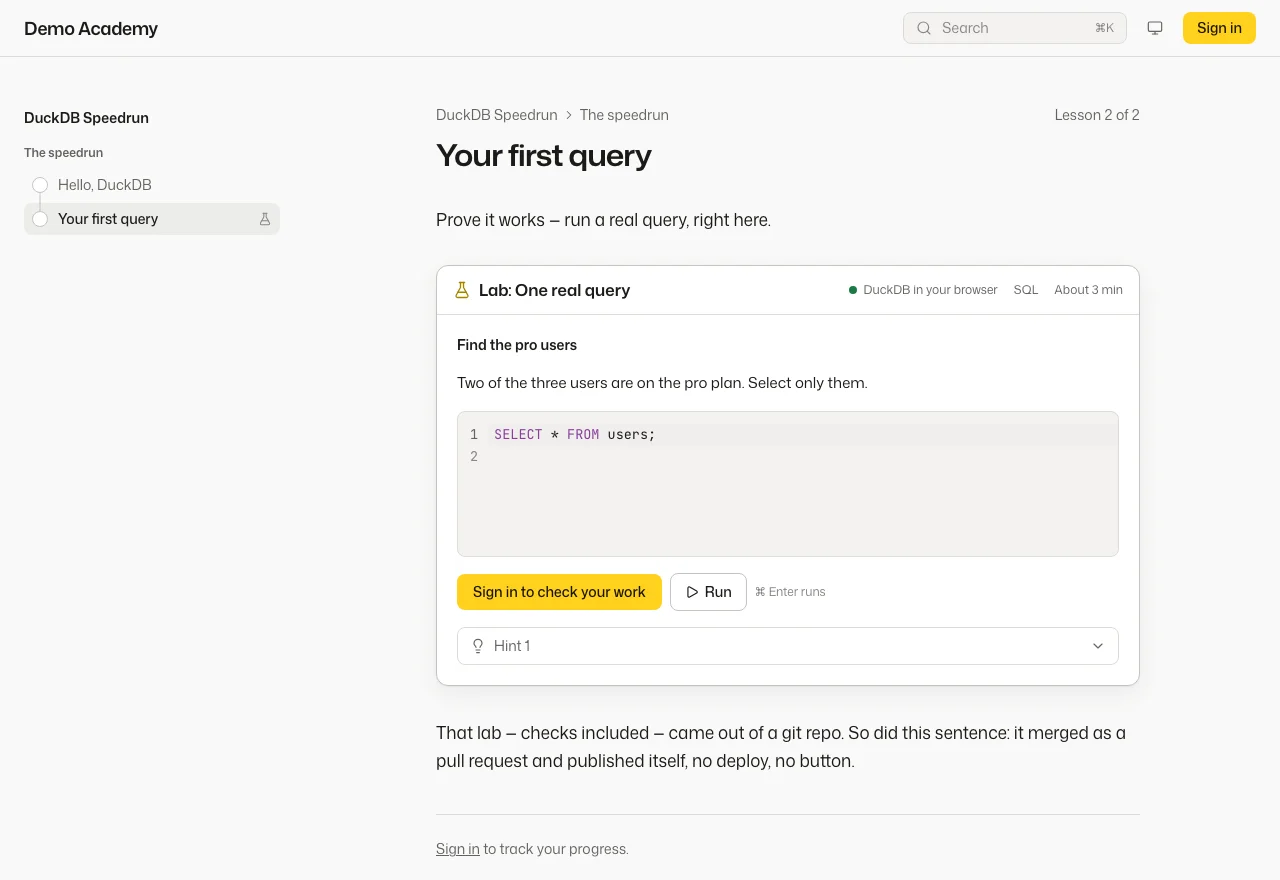
See the Markdown behind a lab
An excerpt from this lesson's source:
```lab
id: speedrun-query
title: 'Lab: One real query'
language: sql
starterCode: |
  SELECT * FROM users;
Content freshness
Know which videos need updating.
As your product evolves, old advice can stay in your courses. Connect your documentation and add video transcripts. Mastria flags claims that conflict with your current docs and shows the passages your team should review.
Run a review after a release, or schedule checks. Your team decides what to change.
Lesson: Handling failed jobs
Video transcript
03:12
“A failed job is retried three times by default.”
Current documentation
docs/jobs/retries.md
“Failed jobs are retried twice by default.”
The default retry count no longer matches.
Review the explanation at 03:12. The finding shows the video quote and the documentation passage together.
See whether learning translates into product use.
Course completions are a start. Connect your product events to see how usage changes among people who finish a course, compared with coworkers who haven't.
Follow progress by customer account. Find where learners drop off. Give your team evidence to decide which courses to improve and where to invest next.
Impact
How did product use change after Getting started?
Share of people with at least one “created pipeline”More is better
- 48 people who finished
- 160 coworkers who hadn't finished
- If they'd changed like their coworkers
| Group | 30 days before finishing | 30 days after |
|---|---|---|
| People who finished | 18% | 41% |
| Coworkers who hadn't finished | 15% | 22% |
| If they'd changed like their coworkers | 18% | 25% |
| Difference | +16 points, likely +5 to +27 |
Launch your academy with the founder.
We're working with three design partners: developer-tool and data teams ready to bring a real course to their users.
- Help with your first course. Setup and migration, directly with Marc.
- A say in what gets built. Use the product and share feedback as your academy grows.
- 50% off for life. Flat subscription pricing with unlimited learners.
Final plan prices are not published yet. We'll agree pricing before you commit. Applying is free and does not commit you to a purchase.
Apply for early access
Tell us who you are. Marc will review your application and follow up by email.
Not ready to apply? Join the waitlist.
Join the waitlist
We'll email you once, when Mastria opens to everyone.
Before you apply
Have a question about your academy? Email Marc.
Is Mastria right for our team?
Mastria is built for developer-tool and data companies teaching customers to use their product. It brings courses, browser-based Python and SQL labs, and product-usage comparisons together. If your main need is compliance training or SCORM packages, it is not the right fit.
What does early access involve?
We are working with three design partners. You bring a real course and feedback from using the platform; Marc helps you launch and works with you on what comes next. Partners get 50% off for life. Applying starts a conversation and does not commit you to a purchase.
How much will it cost?
Mastria will have flat subscription pricing with unlimited learners. Final plan prices are not published yet. Design partners get 50% off for life, and pricing is agreed before you commit. There is no charge to apply.
Can we bring our existing content?
Yes. Courses use Markdown, with an editor and optional GitHub sync. You can embed videos from your existing host. As a design partner, you work directly with Marc on bringing your first course over.
How does the Impact view work?
Send your product events through the metric API or import a CSV. Mastria compares the change in course finishers' activity with the change among coworkers at the same companies, before and after the course. It shows uncertainty and explains the method. The comparison is evidence to investigate, not proof that training caused the difference.
What about SSO and taking our data with us?
Sign-in currently uses email magic links; SSO/SAML is on the roadmap. Courses can live in your own GitHub repo. Learners, progress, certificates, and metric events export as CSV from the admin.